Skip to content

Wideband radio-frequency scenario simulation software

Communications Scenario Generator

Many emitters in one wideband stream, with every parameter known.

Software that generates a wideband radio-frequency scenario of many simultaneous emitters from a scenario file, with a machine-readable list of every emitter's known parameters.

  • Defence and security
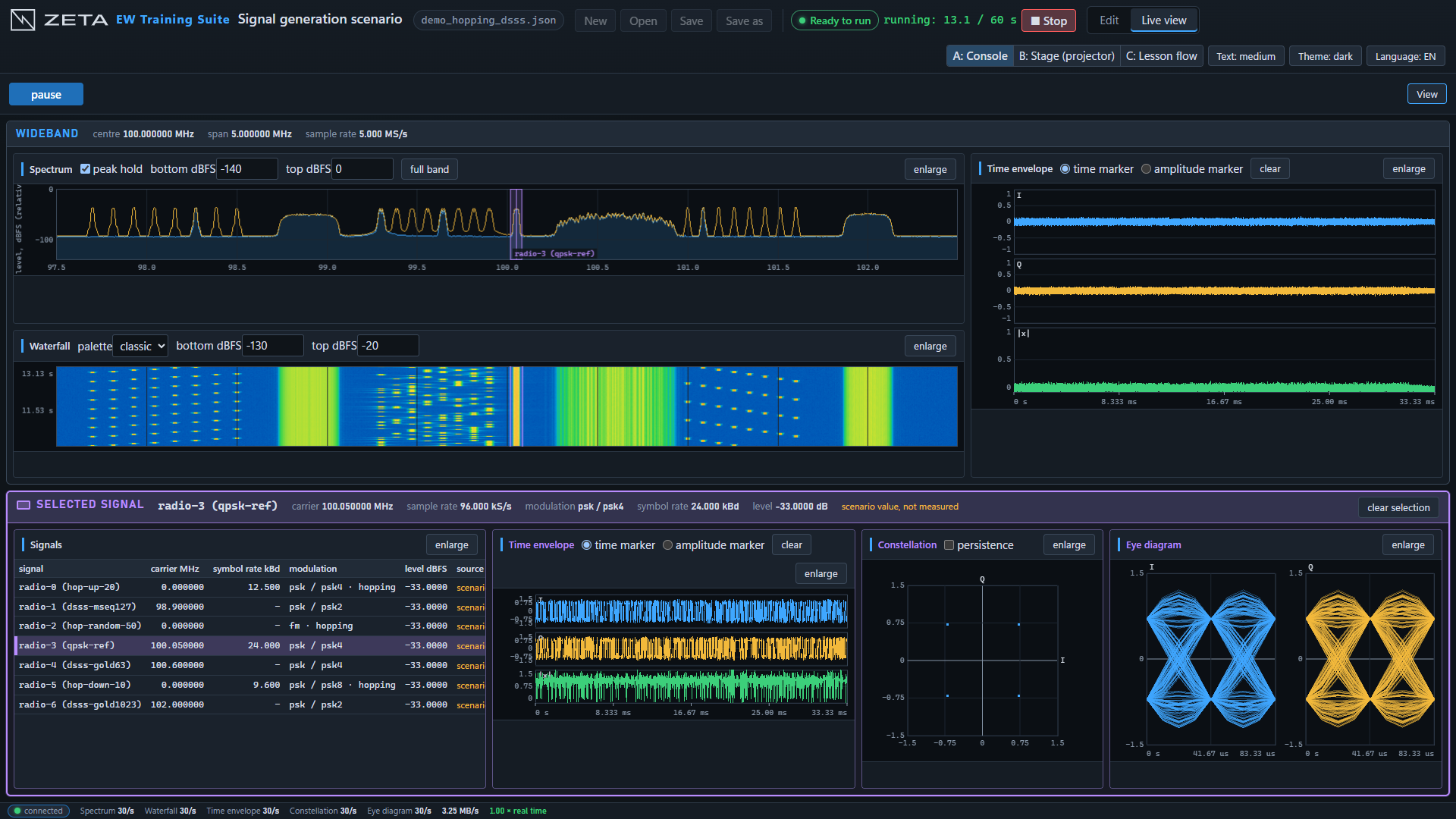
Live view: wideband spectrum and waterfall of frequency-hopping and direct-sequence signals, with the constellation and eye diagram of the selected signal

Overview

A scenario file in, a wideband I/Q stream and its known answers out

Communications Scenario Generator builds a radio-frequency environment entirely in software. Each emitter has its own source, coding, scrambling, interleaving, modulation, spreading or hopping, timing, level and propagation channel; the generator combines all of them into one wideband I/Q stream and writes a file listing the known parameters of every emitter. The stream goes to a file, to the network or to a software-defined radio, so the same scenario can drive a receiver test, a signal analysis system or a training exercise. It is the signal generator of EW Training Suite, offered on its own.

Key capabilities

  • Scenarios on a frequency–time plan

    01

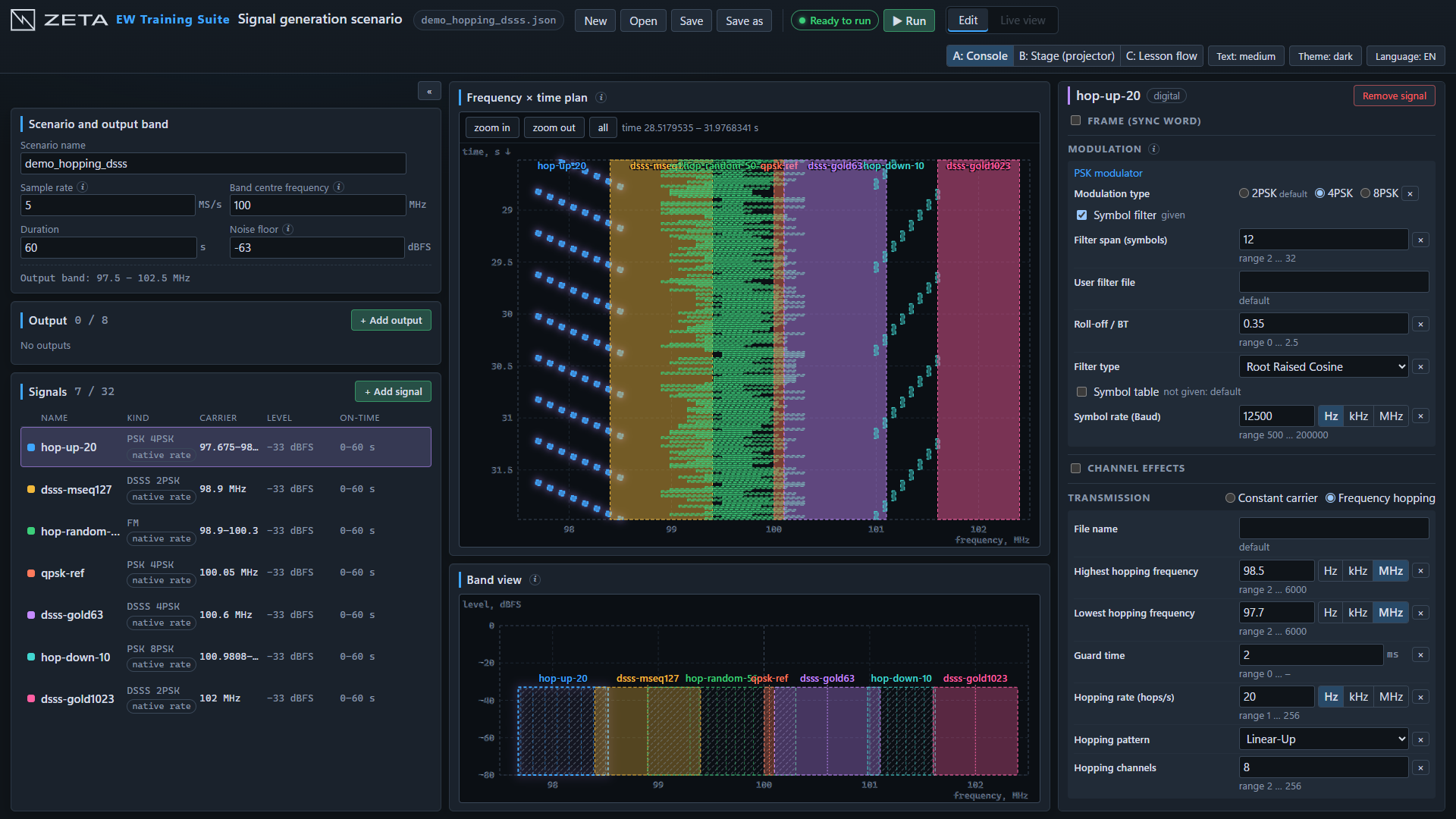
    The scenario page shows every emitter on a frequency–time plan and in a band view, with a parameter panel that lists ranges and defaults and validates the scenario before it runs. Each emitter has its own on-air windows and level; a total level cap scales all emitters together when their sum would clip. Scenarios are stored as files, and the same scenario runs from the command line.

  • Communication and radar waveforms

    02

    Sources range from random bits, bit files, frames and Morse text to tones, audio files and I/Q recordings. Each emitter is coded, scrambled, interleaved and modulated in its own chain, then sent as a constant carrier, in bursts or TDMA time slots, by frequency hopping or with direct-sequence spreading. Radar emitters are pulsed or CW, with agile pulse width, pulse repetition interval and carrier, and intra-pulse modulation.

  • Propagation channels

    03

    Each emitter can pass through an ITU-R F.1487 HF channel (latitude, condition, NVIS), an ETSI EN 300 392-2 VHF/UHF land-mobile channel (static, rural, typical urban, bad urban, hilly terrain, equaliser test, with vehicle speed) or a custom multipath channel with per-tap delay, gain, Doppler and Rice factor, plus frequency offset and phase noise.

  • File, network and radio outputs

    04

    The wideband stream is written as raw int16 I/Q or VITA-49 with SigMF metadata, sent over UDP as raw I/Q or VITA-49, or radiated through a software-defined radio. A scenario runs in real time or at a chosen speed ratio, so long scenarios can be rendered to file faster than real time.

  • Known answers for every emitter

    05

    Alongside the signal, the generator writes a machine-readable expected-result file with every emitter's carrier, level, timing, modulation, rates, codes and channel, and its ITU emission designation and necessary bandwidth under ITU-R SM.1138. The same scenario and seed give the same signal, so a receiver or analysis system can be scored automatically against the known answer.

  • Scales with the workstation

    06

    A scenario holds 256 emitters with 32 on air at once by default, configurable up to 1024 and 128, at output sample rates of up to 125 MS/s. Generation runs on the processor's cores and the wideband output stage can move to an NVIDIA GPU, so real-time capacity grows with the workstation. It runs on Windows 11 and Linux.

Applications

Defence and security

  • Test signals for receivers, direction finders and signal analysis systems
  • Automatic scoring of detection, recognition and decoding against known answers
  • Signal environments for EW operator training
  • Repeatable acceptance and regression test scenarios

Specifications

Signals per scenario
256 by default, configurable up to 1024
Signals on air at once
32 by default, configurable up to 128
Output sample rate
Configurable, up to 125 MS/s
Real-time capacity
Scales with the workstation's processor cores; optional NVIDIA GPU output stage
Signal sources
Random bits, bit files, bit editor, sync words and frames, Morse text, tones, noise, audio files (WAV, MP3, FLAC, Ogg Opus), I/Q recordings
Analogue modulation
AM, FM, USB, LSB, CW (Morse)
Digital modulation
2/4/8-PSK; 16, 32, 64, 128 and 256-QAM; 2–64 FSK, MFSK, CPFSK, MSK, GMSK
Pulse shaping
Root raised cosine, raised cosine, Gaussian, rectangular, user-defined filter
Error-correction coding
Convolutional (including punctured), Reed-Solomon, BCH, turbo
Interleaving and scrambling
Block, convolutional and matrix interleavers; additive and self-synchronising scramblers
Spread spectrum
Direct sequence (m-sequence and Gold codes), frequency hopping with selectable patterns, rates and channel sets
Multiple access
FDMA, TDMA groups (time slots), burst transmission
Radar
Pulsed and CW; pulse width, PRI and carrier stable, wobbulated, jittered, staggered or dwell-switched; intra-pulse modulation
Channel models
ITU-R F.1487 HF (latitude, condition, NVIS); ETSI EN 300 392-2 VHF/UHF (static, RA, TU, BU, HT, EQ, vehicle speed); custom multipath with delay, gain, Doppler and Rice factor; frequency offset; phase noise
Level control
Per-signal level in dBFS, noise floor, total level cap with common scaling
Outputs
File (raw int16 I/Q or VITA-49, with SigMF metadata), UDP (raw or VITA-49), SDR
Run speed
Real time or a chosen speed ratio
Expected-result file
Known parameters of every emitter, with ITU emission designation and necessary bandwidth (ITU-R SM.1138)
Repeatability
The same scenario and seed give the same signal
Interfaces
Web-based scenario page served by a local station program; command-line tool
Operating system
Windows 11, Linux

Detailed specifications and export information are available on request.