Skip to content

Signal generation and analysis software for electronic warfare training

EW Training Suite

Signal scenarios with known answers, and the tools to analyse them.

Classroom software that generates a congested radio-frequency environment from an instructor's scenario, with the parameters of every signal known, and gives each trainee the tools to detect, measure, demodulate and decode the signals in it.

  • Defence and security
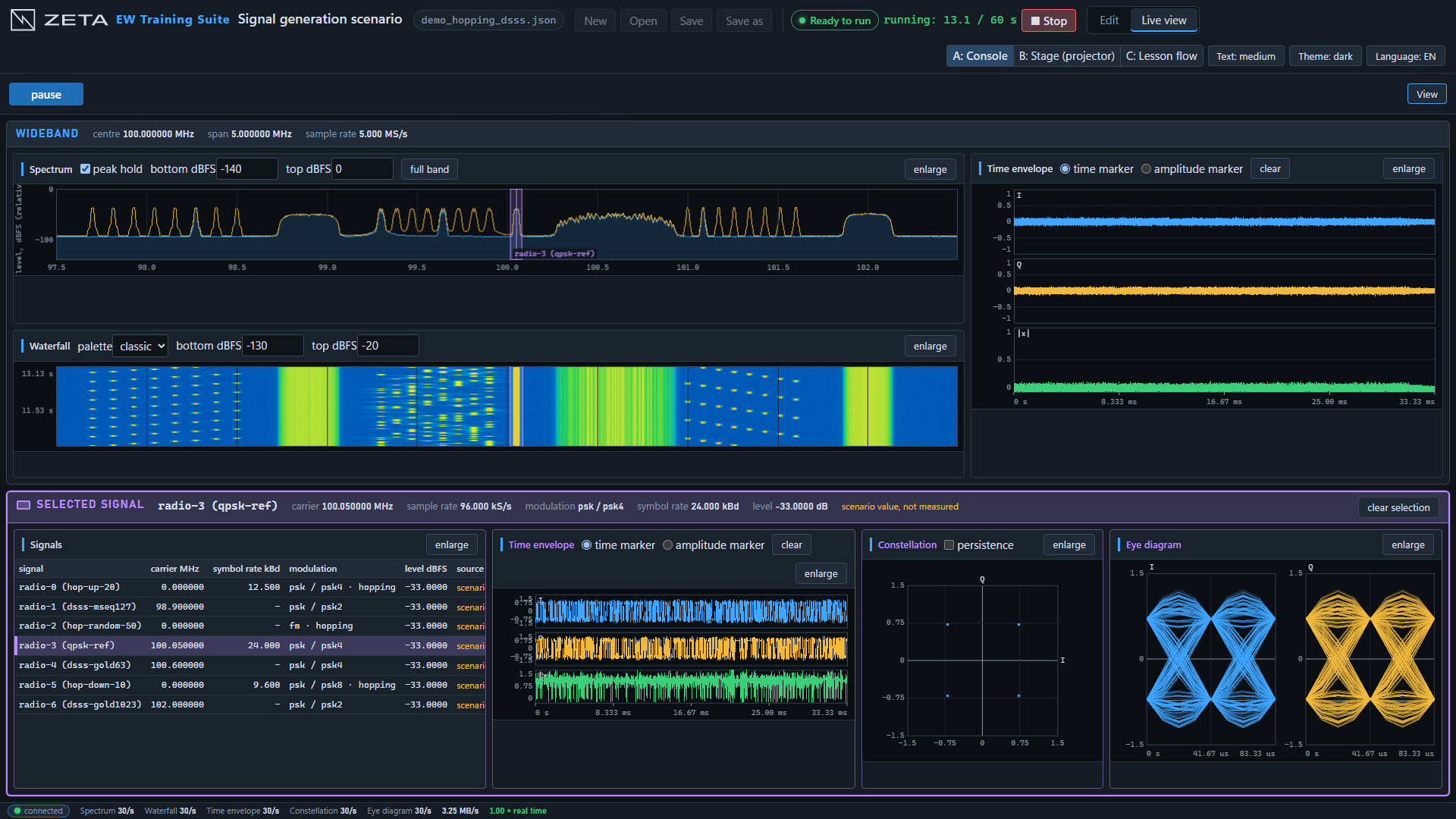
Live view: wideband spectrum and waterfall of a scenario with frequency-hopping and direct-sequence signals, and the constellation and eye diagram of the selected signal

Overview

The instructor defines every signal in the band, so every exercise has a known answer

EW Training Suite is a classroom system for training signal analysts. The instructor builds a scenario on a frequency–time plan from analogue, digital, spread-spectrum, multiple-access and radar signals, each with its own internal and external characteristics. The generator synthesises the scenario into one wideband I/Q stream, passes it through HF or VHF/UHF propagation channels, and writes a file listing the known parameters of every signal. Each trainee works the same sequence as on a live collection task: survey the band, select and isolate a signal, measure it, demodulate it and analyse the recovered bits, then compare the result with the known answer.

Key capabilities

  • A congested spectrum that scales with the workstation

    01

    The generator combines every signal of a scenario into one wideband I/Q stream at an output sample rate of up to 125 MS/s. By default a scenario holds 256 signals with 32 on air at once; both limits are configurable, up to 1024 and 128. Real-time capacity grows with the workstation: generation runs on the processor's cores, and the wideband output stage can move to an NVIDIA GPU. No RF hardware is required.

  • Scenarios on a frequency–time plan

    02

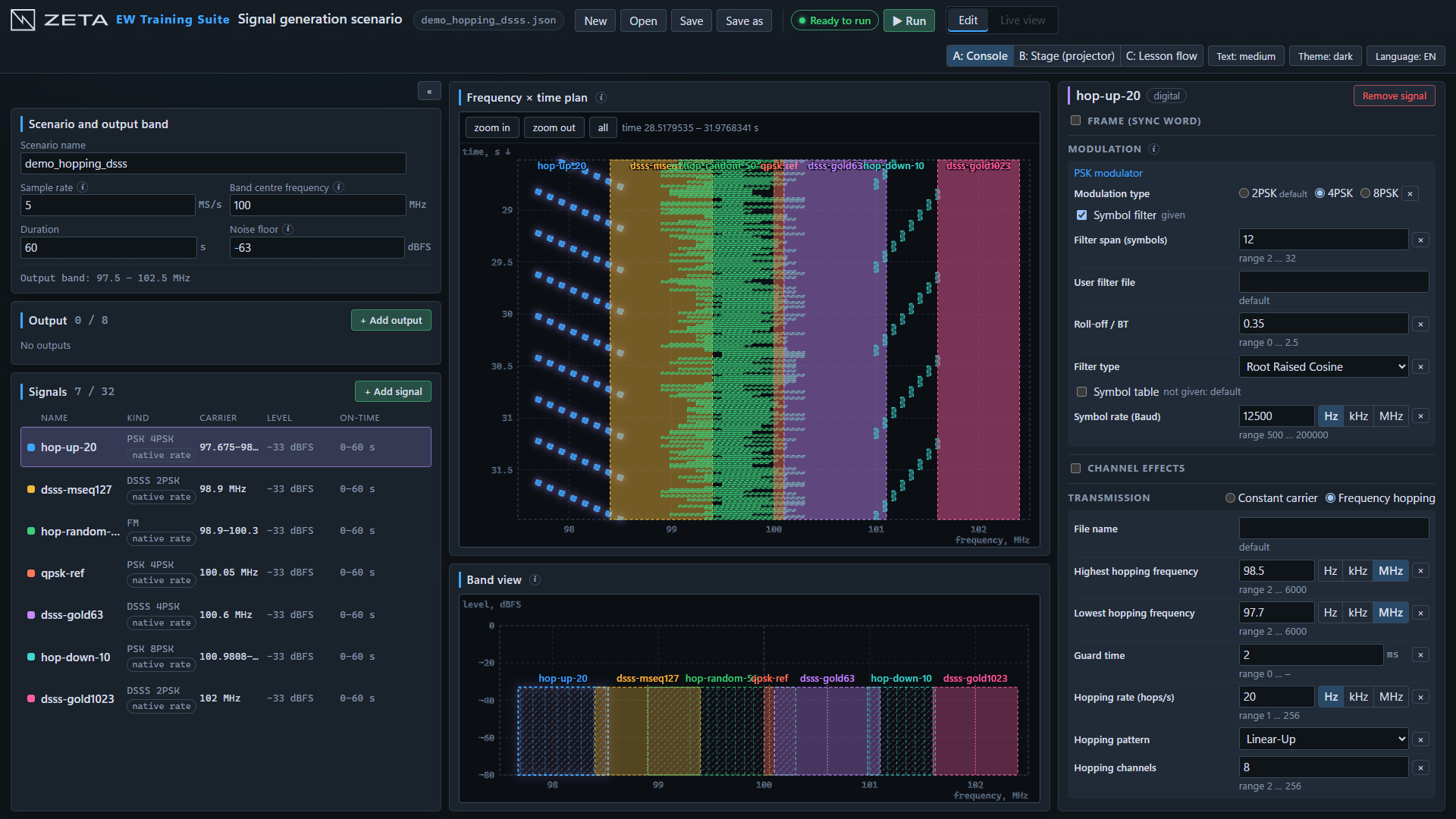
    The scenario page shows every signal on a frequency–time plan and in a band view, with its own carrier, level, on-time and parameter panel. Scenarios are validated before they run, stored as files, and reused and shared across the class. The same scenario and seed give the same signal on every run, so an exercise can be repeated and assessed exactly.

  • Communication and radar signals

    03

    Each communication signal passes through its own chain: bit source, forward error correction, scrambling, interleaving, an optional frame sync word, modulation, and transmission as a constant carrier, frequency hopping or bursts; direct-sequence spreading uses m-sequence or Gold codes. Radar signals are pulsed or CW, with pulse width, pulse repetition interval and carrier each stable, wobbulated, jittered, staggered or dwell-switched, and with intra-pulse modulation.

  • Propagation channels

    04

    Channel effects apply the ITU-R F.1487 HF and ETSI EN 300 392-2 VHF/UHF fading models, custom multipath, frequency offset, phase noise and a noise floor. Trainees meet signals as they arrive over the air, not as clean waveforms.

  • Manual and automated signal analysis

    05

    The trainee station shows the wideband spectrum and waterfall with markers that read frequency, bandwidth and amplitude. A signal selected on the display is isolated by a digital down-converter and shown in the time, frequency and amplitude domains, with constellation and eye diagram. Automated analysis identifies the modulation type and measures the symbol rate. Each trainee can pause, step through and revisit the signal history at their own pace.

  • From demodulation to bit structure

    06

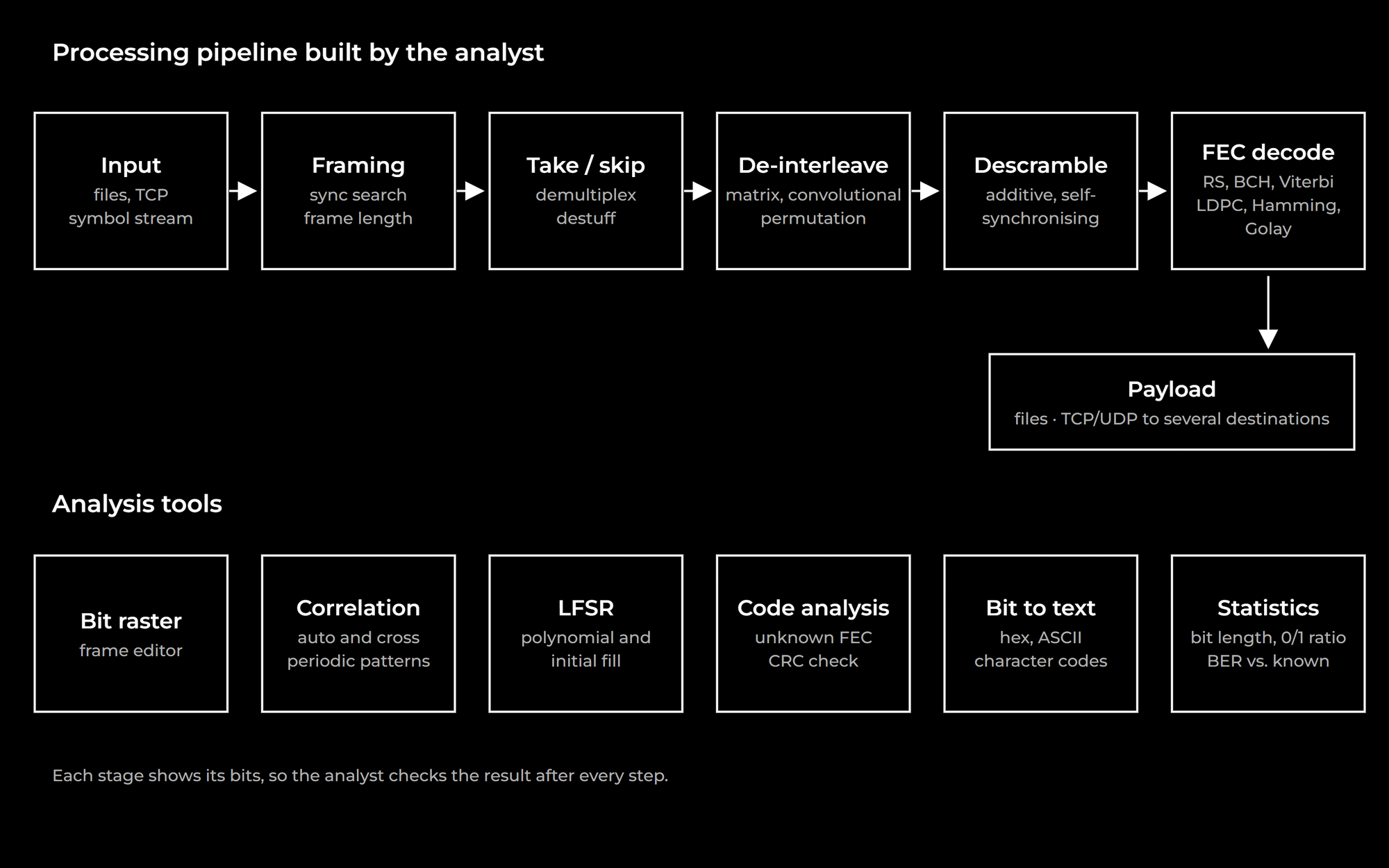
    Digital demodulation recovers symbols and bits with a live constellation and shows the result as a bit raster and in hexadecimal and ASCII; analogue demodulation gives audio and modulation measurements such as modulation index. Bit-level tools find frame length and preamble period, remove frame bits with take and skip, recover a linear-feedback shift register's polynomial and initial fill, and measure bit error rate against a known bit stream.

  • Networked classroom and standalone study

    07

    In the classroom the instructor station sends the scenario and its seed, and each trainee station generates and analyses the same band locally on a common scenario clock. Network load does not grow with the number of positions, and a station that fails does not affect the others. A station that joins late is brought to the current state, and the exercise can be paused and resumed. Without a network, a trainee works standalone from a stored scenario.

  • Analysis developed together with SentinelIQ

    08

    EW Training Suite and ZETA's SentinelIQ signal analysis engine were developed together, on a shared data format for I/Q data and expected results and a shared signal-processing library. The generator produces long HF, VHF and UHF scenarios and labelled bit streams with known answers, against which SentinelIQ's channel extraction, decoding of digital voice and analogue channels, and blind frame-structure analysis are scored automatically.

Applications

Defence and security

  • Signal analyst and EW operator training
  • COMINT and ELINT classroom instruction
  • Assessment against known signal parameters
  • Known-answer test scenarios for signal analysis software
  • Individual study and refresher training

Specifications

Signals per scenario
256 by default, configurable up to 1024
Signals on air at once
32 by default, configurable up to 128
Output sample rate
Configurable, up to 125 MS/s
Real-time capacity
Scales with the workstation's processor cores; optional NVIDIA GPU output stage
Analogue modulation
AM, FM, USB, LSB, CW (Morse)
Digital modulation
2/4/8-PSK; 16, 32, 64, 128 and 256-QAM; 2–64 FSK, MFSK, CPFSK, MSK, GMSK
Error-correction coding
Convolutional, Reed-Solomon, BCH, turbo
Interleaving and scrambling
Block, convolutional and matrix interleavers; additive and self-synchronising scramblers
Spread spectrum
Direct sequence (m-sequence and Gold codes), frequency hopping
Multiple access
FDMA, TDMA (burst and time-slotted waveforms)
Radar
Pulsed and CW; pulse width, PRI and carrier stable, wobbulated, jittered, staggered or dwell-switched; intra-pulse modulation (tone, Barker, LFM, phase)
Channel models
ITU-R F.1487 (HF), ETSI EN 300 392-2 (VHF/UHF), custom multipath, frequency offset, phase noise
Analysis
Spectrum and waterfall markers, digital down-conversion, time, frequency and amplitude views, modulation-type and symbol-rate detection
Bit-level analysis
Frame length and preamble period, take and skip, LFSR polynomial and initial fill, bit error rate
Repeatability
The same scenario and seed give the same signal
Interfaces
Raw int16 I/Q and VITA-49 to file, UDP or SDR; SigMF metadata
Expected-result file
Known parameters of every signal, machine-readable
Operating modes
Networked classroom; standalone from a stored scenario
Operating system
Windows 11, Linux

Detailed specifications and export information are available on request.