Skip to content

Signal demodulation and protocol decoding software

SentinelIQ

From channel I/Q to decoded calls, messages and pictures, each one checked.

Software that demodulates and decodes radio channels, from digital voice and trunked radio to HF data modems and maritime and aviation links, and returns events, audio, data and call records, each marked as verified by the protocol's own checks or not.

  • Defence and security
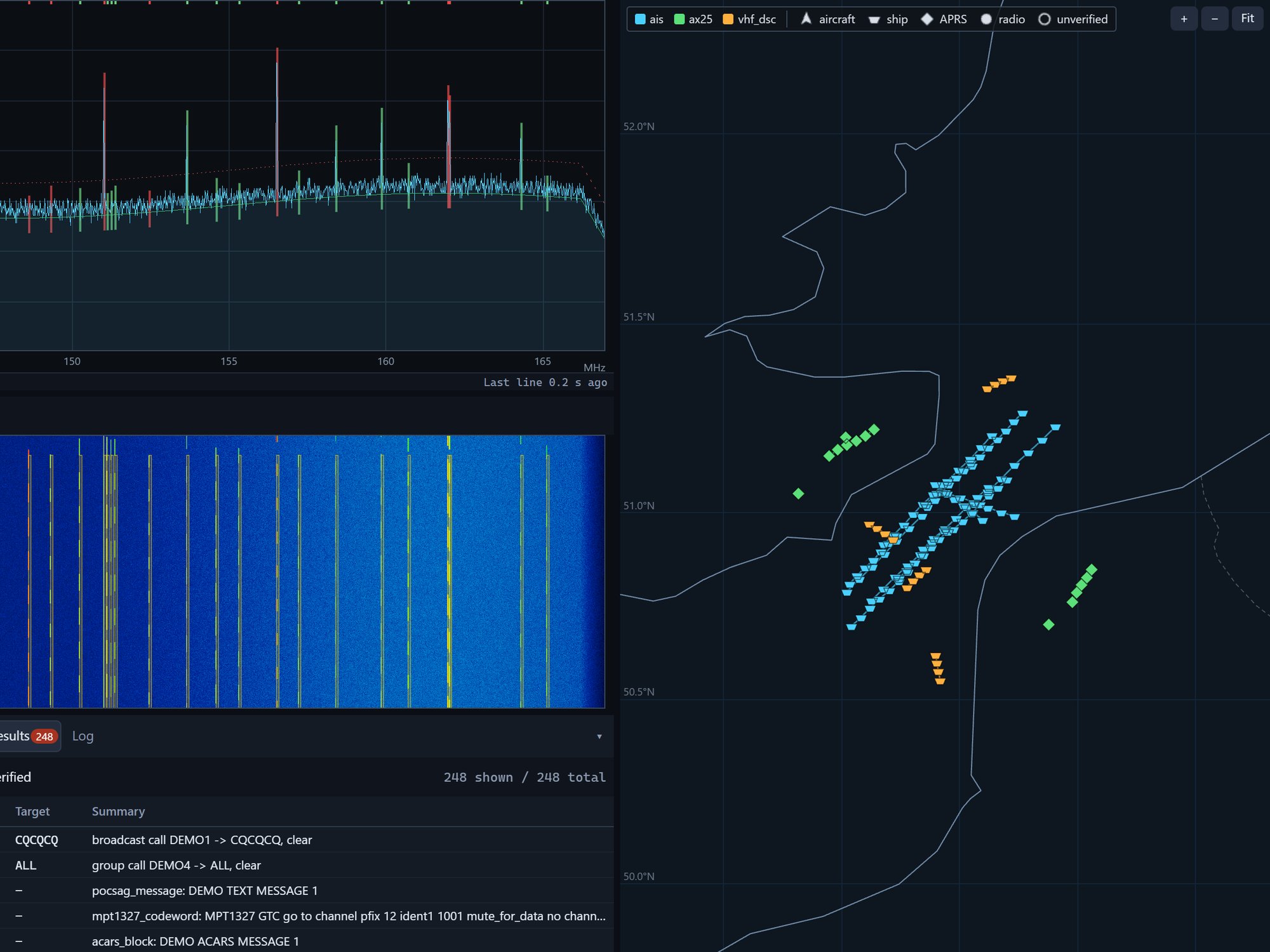
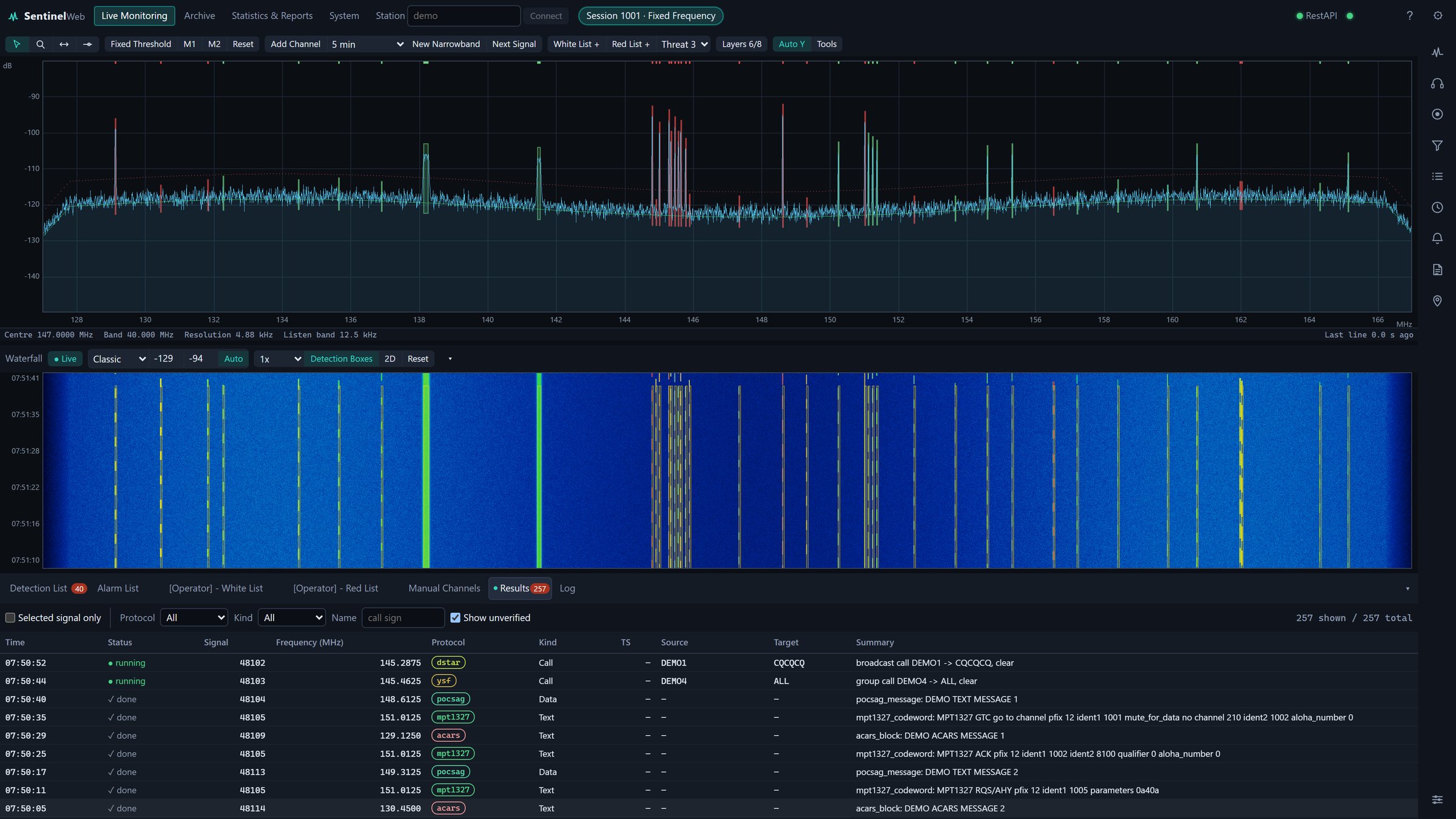
Sentinel console: spectrum, waterfall and decoded results, with the SentinelIQ positions map showing the tracks of AIS and DSC ships in a coastal shipping area and APRS stations on land

Overview

The decoding engine of a monitoring system

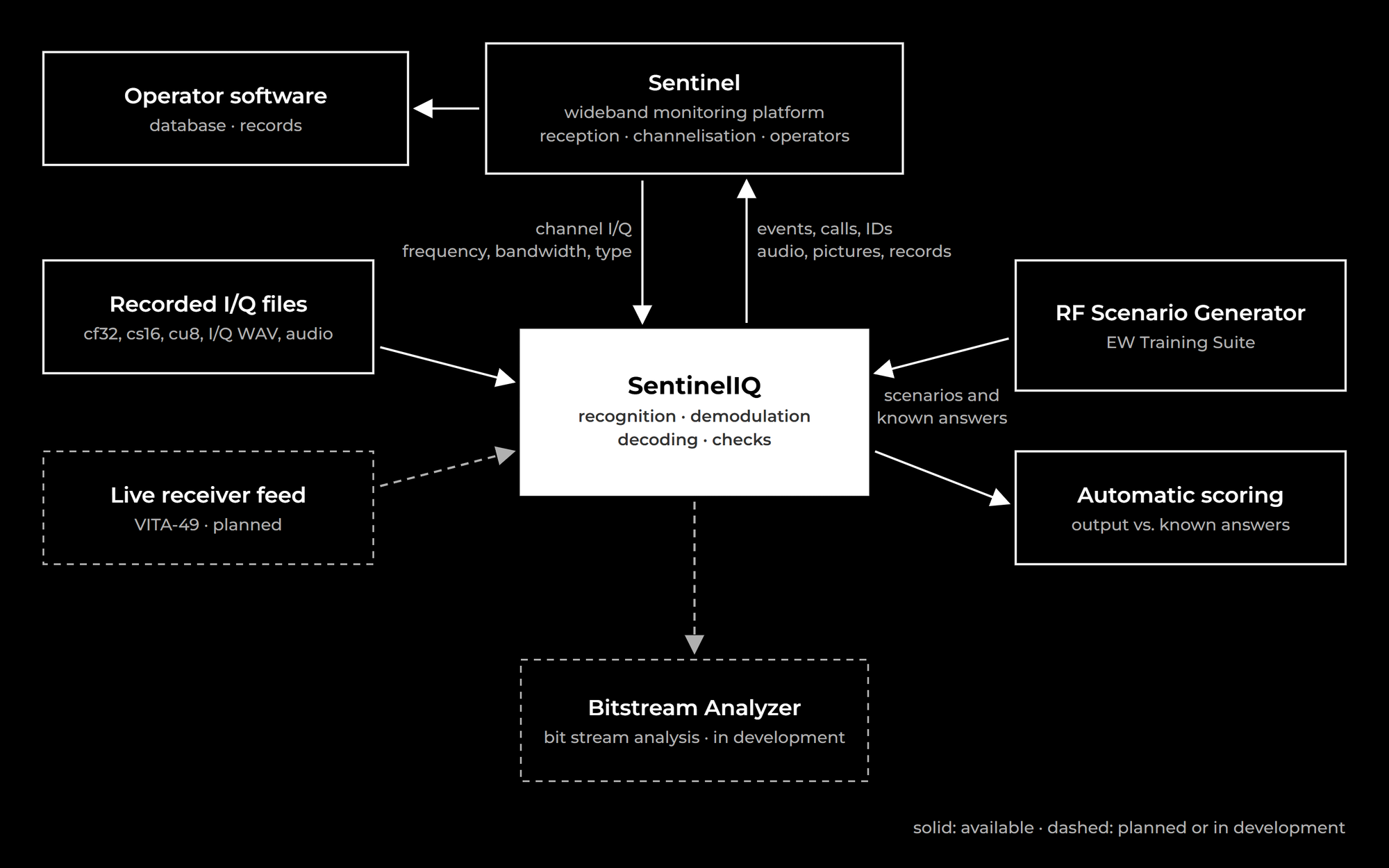
SentinelIQ takes one radio channel at a time, as I/Q samples or audio from a file or a live stream, together with its frequency and bandwidth, recognises its modulation when the protocol is not given, and returns what the transmission carried: call start and end, IDs, call type and encryption state, data messages, positions, text, pictures and audio. A decoder locks only when the protocol's own checks pass, so silence, noise and mirrored signals do not turn into false traffic, and every output states whether a check verified it. Reception, channelisation and activity detection belong to the host system: SentinelIQ runs inside Sentinel, ZETA's wideband monitoring platform, as its decoding engine, as a service for other systems, or from the command line on recordings.

Key capabilities

  • Voice, trunking, HF data and aviation links

    01

    Digital voice and trunked radio (D-STAR, Yaesu System Fusion, MPT 1327), analogue voice with tone and selective calling, HF data modems from STANAG 4285 and MIL-STD-188-110 to ALE and a wide set of national and manufacturer modems, maritime and aviation links (HFDL, ACARS, VDL Mode 2, AIS, DSC, NAVTEX) and amateur and commercial HF data. The full list, including what is in development and planned, is in the specifications.

  • Decoders lock only on passed checks

    02

    Each decoder uses the error detection and correction its protocol carries (CRC, Reed-Solomon, Golay, BCH, parity, Viterbi metrics) to decide whether it has found real traffic. Silence, noise and mirrored signals are rejected instead of producing invented calls, and every event, message and picture is delivered with a flag saying whether a check verified it.

  • Events, audio, data and records

    03

    Events report call start, update and end with IDs, call type and encryption state. Audio is delivered as WAV or Opus, with the raw vocoder frames kept alongside; fax and SSTV pictures as PNG; data messages, positions and text as structured records; and every call leaves a record per channel. Encrypted traffic is flagged as encrypted and is decrypted only with a key the operator supplies.

  • Decoded positions on the map

    04

    Positions carried in the traffic, such as APRS, AIS, DSC and HFDL aircraft reports, are decoded with the rest of each transmission. In Sentinel they appear on a map with each emitter's track, next to the spectrum and the live results and in the results archive; positions a check did not verify are drawn apart, and each fix opens its full decoded record.

  • Modulation recognition and blind demodulation

    05

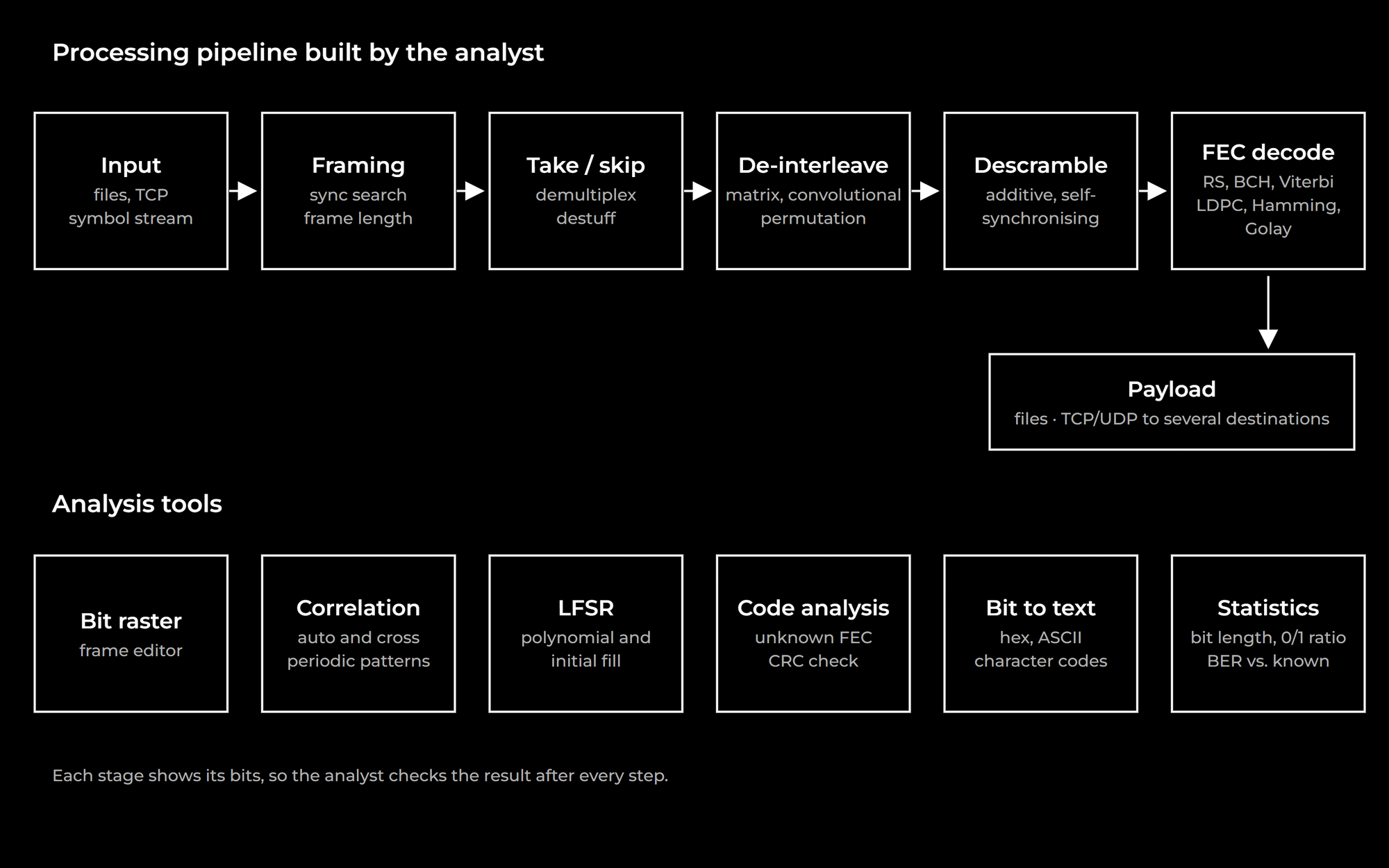
    Automatic modulation recognition sorts each channel into analogue, PMR family or generic digital classes, so a channel can be routed to the right decoder without being labelled first. When a signal's protocol is not known, blind demodulators for PSK2/4/8, DPSK, OQPSK, FSK2/4/8, CPFSK, GMSK and AFSK recover its symbols for further analysis, for example in Bitstream Analyzer. Blind analysis of the frame structure is in development.

  • Built to work inside other systems

    06

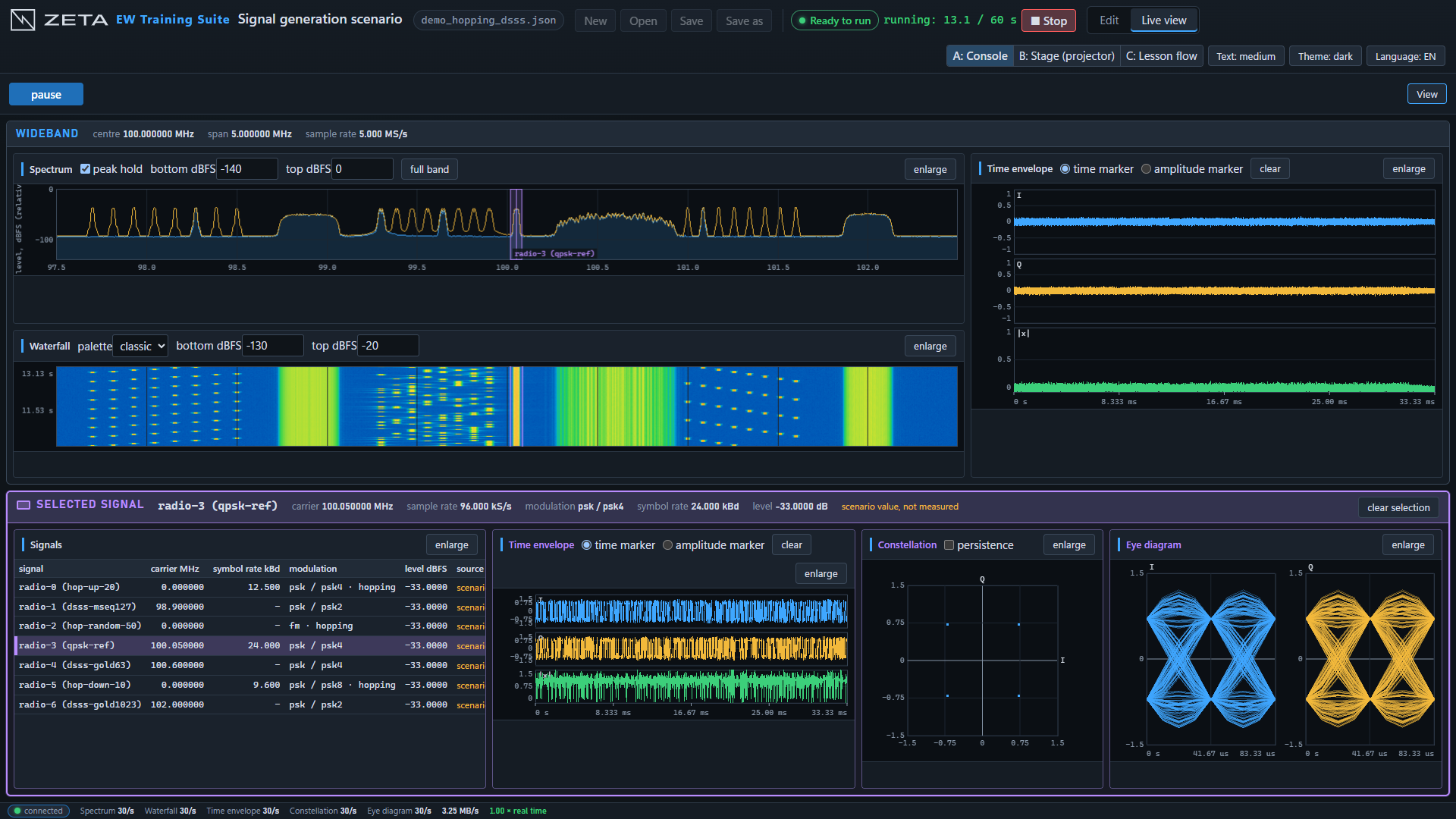
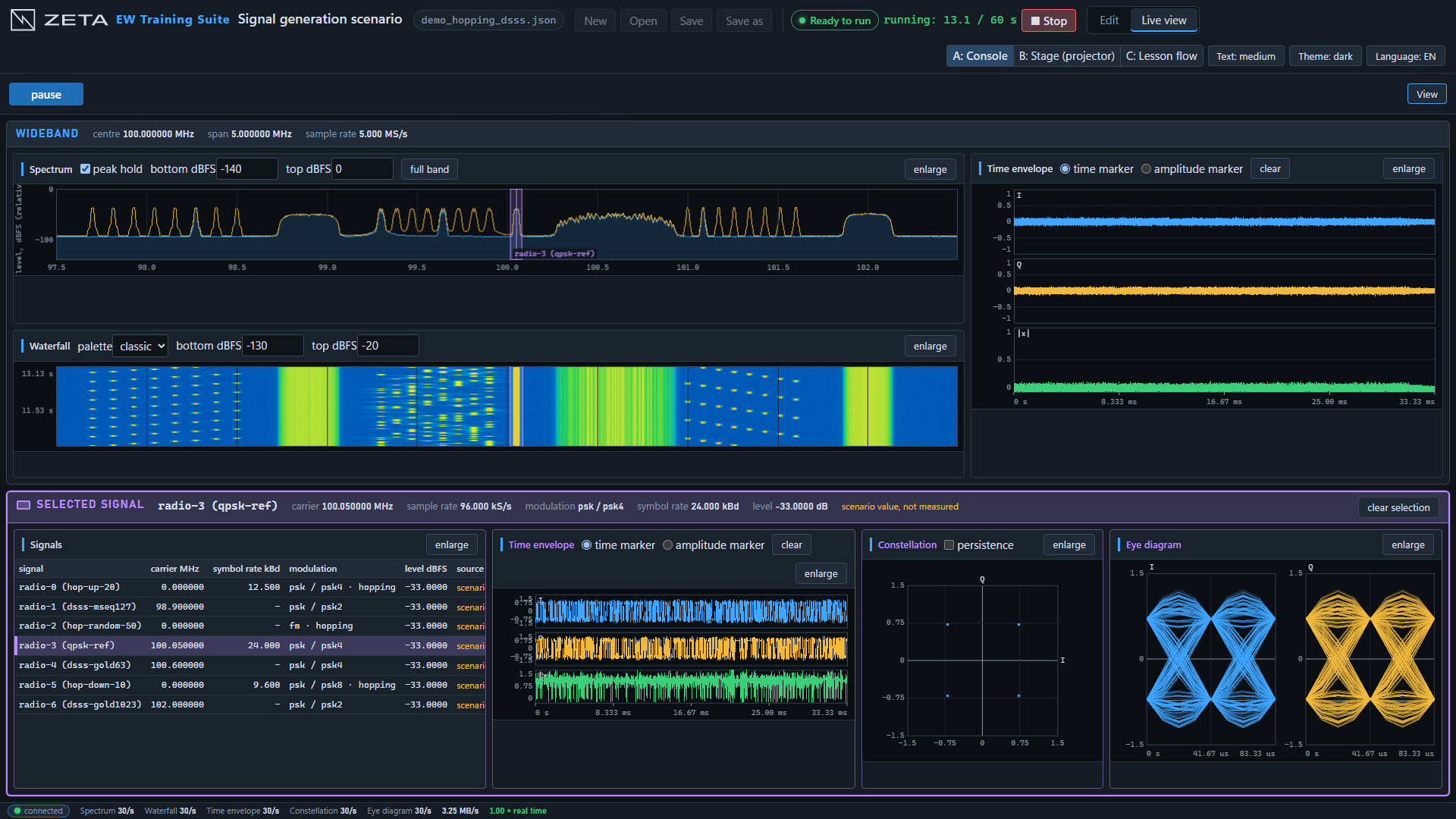
    The service speaks a packet protocol over TCP or a local socket: clients subscribe to channels and outputs, reconnect and replay what they missed, are told about gaps and receive per-channel statistics. The same decoders are available as a C++ library and from the command line, file in and files out. With Communications Scenario Generator and EW Training Suite, SentinelIQ output is scored automatically against each scenario's known answers.

  • Many channels on one host

    07

    One process decodes many channels at once, one decoder per channel, and several instances run side by side on one host, so capacity grows with the number of processor cores. SentinelIQ runs as a Linux or Windows service, and in Docker or WSL. Live input from receivers over VITA-49 is planned.

Applications

Defence and security

  • Decoding engine of wideband monitoring and communications intelligence systems
  • Analysis of recorded I/Q and audio after a mission
  • Decoding of HF, VHF and UHF voice and data traffic for security agencies
  • Decoder under test in EW training and acceptance, scored against known scenarios

Specifications

Input
Recorded files: channel I/Q (cf32, cs16, cu8), stereo I/Q WAV or audio WAV, including 24-bit, at any sample rate; live I/Q stream
Channels
One decoder per channel; many channels per process; several instances per host
Operating systems
Linux and Windows service; Docker or WSL
Encrypted traffic
Flagged as encrypted; decrypted only with a key the operator supplies
Channelisation
Done by the host system; VITA-49 receiver input planned
Lock criteria
Protocol checks: CRC, Reed-Solomon, Golay, BCH, parity, Viterbi metrics; silence, noise and mirrored signals rejected
Modulation recognition
Automatic, per channel: analogue, PMR family, generic digital classes
Outputs
Events (IDs, call type, encryption state), data messages, positions, text, pictures (PNG), audio (WAV, Opus), raw vocoder frames, call records; each item marked verified or not
Interfaces
Service over TCP or a local socket (subscriptions, reconnect with replay, gap reporting, per-channel statistics); C++ library; command line
Digital voice and trunked radio
D-STAR (DV), Yaesu System Fusion (C4FM), MPT 1327 control channel
Digital voice: planned
TETRAPOL
Analogue voice
AM, SSB (USB, LSB, ISB), NBFM; voice inversion descrambling
Analogue voice: planned
Wideband FM broadcast
Tones and selective calling
Sequential tones ZVEI, CCIR, EEA, EIA, EURO, NATEL, MODAT, CCITT, PCCIR; DTMF; CTCSS; DCS; ICAO SELCAL; MDC-1200; FleetSync I/II; CCIR 493-4 HF selcall (Codan, Barrett, Q-MAC)
HF data modems: standard
STANAG 4285 (all nine modes), MIL-STD-188-110A serial tone, MIL-STD-188-110 Appendix C / STANAG 4539 high data rate, STANAG 5066 (passive), 2G ALE (MIL-STD-188-141), ALE-400, MD-674
HF data modems: national and manufacturer
ALIS, ALIS-2, CIS-11, CIS-14, CIS-36, CIS MFSK-11 (TEAC KV-11), TEAC KV-17, AKKORD, ACS-C (Vishnya), Akula, Keguri, Nokia M/90, XPA2, MEROD, AN/PRC-138, AN/PRC-525, GJB2076-94 2G ALE, GJB2077-94 2G ALE, Harris RF3560C, Harris RF5710A, Harris RF5710A-MD001, HF-9000, Invelco MD-571-A, KOSREP, RF-41A00 ALE, Rockwell URG-III
HF data modems: in development
MIL-STD-188-110 Appendix A (16-tone) and Appendix D (wideband), STANAG 4539 Annex D TDMA / Link-22, Akula-II, Chayka-I, Chayka-II, Tandeme selcall, AT-3004D xPSK burst, AT-3104D, Grintek MHF-50, Harris AutoLink, Omsk MDM-9.6, PRC64, Selex Elsag HF2000 ALE, Siemens CHP-200, Tadiran AutoCall, TE-204, TEAC KV7, TJN-905
HF data modems: planned
3G ALE (STANAG 4538), MIL-STD-188-110 Appendix B (39-tone), Artek-0.5, Artek-1HF, Artek-OTAR, Bozon-2M, ChVK-W, PBO Page, R-785 OTAR, R-187BV, R-149MA1, R-101-5, AN/PRC-150, AN/USC-42, AW-448, CIS 16FSKv2, Codan CAST, Datron SC3, Datron CCIR476-2, Dicom R-150S F1D, DPRK 1200 baud MSK, DUP-ARQ, DUP-ARQ-II, GJB2077A-2007 3G ALE, Grintek TR-250, Hanjinetc HDM-320 ALE/Data, Hanjinetc HS-5KS, Hart SMART, Huneed VSC-870K, JFRC-F70 ALE/Data, KAN X.25, Kato SB, Keguri 1200 baud and continuous modes, KFF-61, KL-43, M150, MAFF v1, MAFF v2, MID, MIR, Motorola/Vertex MessageCall, MSTC X.25, Necode 321ARX, Necode 322ARX, PBC-146BS, QM9080, RH5-478, RF-41A00 Data, RFSM MIL-STD-188-110A/110B, RFSM FLARQ, RFSM-3000, Racal TRA-3910, Selex H700, Selex HF AIS, Serdolik Carnelian Sarah, ShiDao MIL-STD-188-110A, Spectra C2, Spectra OFDM, Tadiran FLASH, Tadiran RT2300, Tadiran SuperneT ST2300, TEAC KV8, TEAC KV11v2, TEAC KV11W, TEAC KV13, TEAC KV21, TgS-1, TJN-903, TJN-907, Vyshka selcall, WT6000, XD-D12B, XD-D9B1, XMP-A, XMP-B
Maritime, aviation and paging
HFDL, ACARS, VDL Mode 2, AIS, GMDSS DSC (MF/HF, VHF ch 70), NAVTEX / SITOR-B, SITOR-A, ARQ-M2, ARQ-M4, WEFAX, SSTV (12 modes), POCSAG
Amateur and commercial HF data
VARA HF, VARA SAT, VARA FM (VarAC, Winlink), AX.25 / APRS 1200 and 9600 baud, FT8, FT4, WSPR, PSK31, MFSK16, CW to text
Amateur and commercial HF data: planned or in development
PSK63 and QPSK/FEC variants, PACTOR 1–4, ARDOP, CLOVER-II, CLOVER-2000, FreeDV / Codec2, Feld Hell
Blind demodulation
PSK2/4/8, DPSK, OQPSK, FSK2/4/8, CPFSK, GMSK, AFSK
Blind frame-structure analysis
In development

Detailed specifications and export information are available on request.