Radar threat monitoring and analysis software
RTMA
From digital receiver data to a live picture of the radar emitters in the environment.
GPU-accelerated ELINT software that processes up to one million radar pulses per second from digital receivers, separates and analyses the emitters and identifies them against a threat library.
- Defence and security
Overview
GPU-accelerated ELINT for dense signal environments
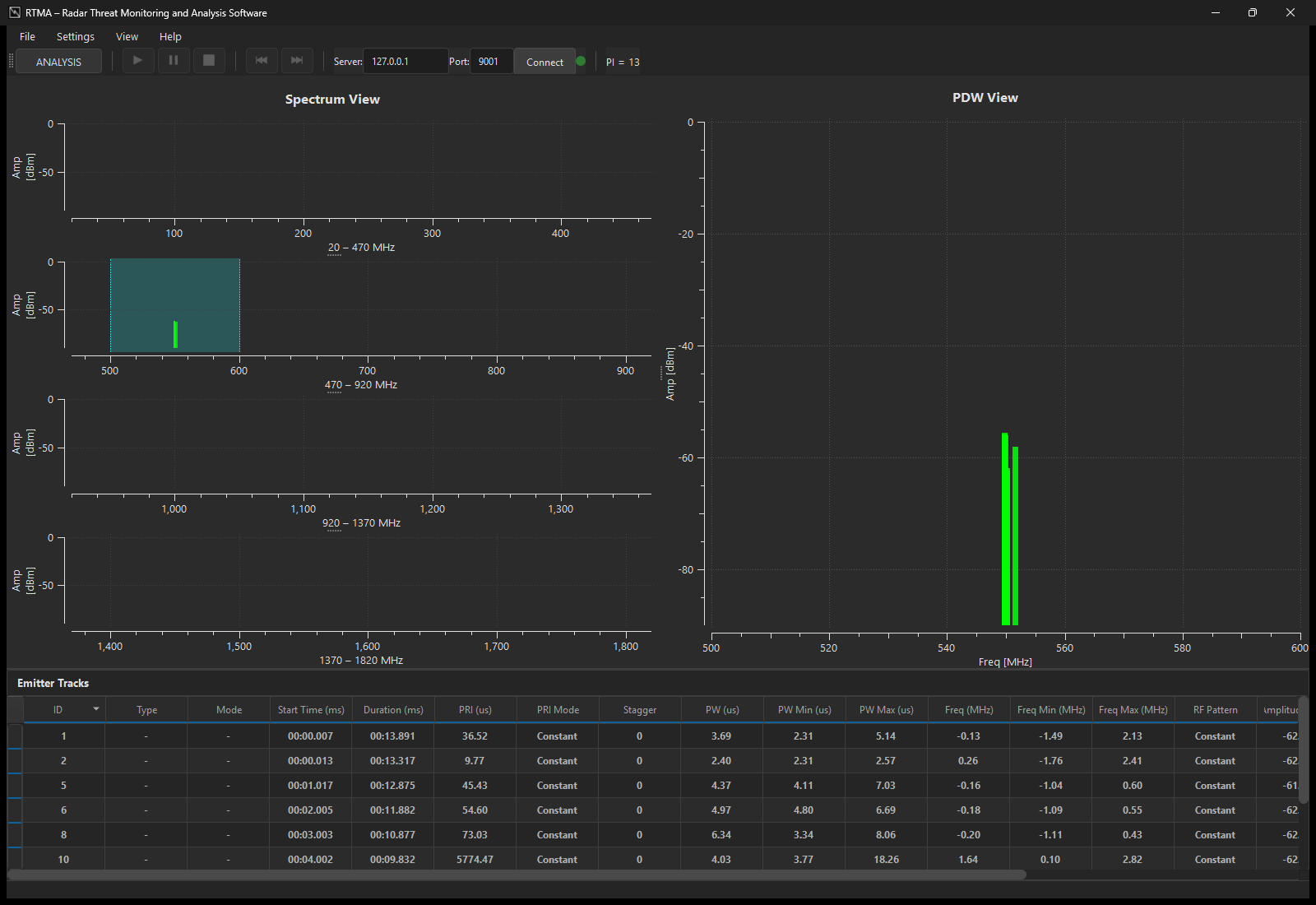
RTMA is a GPU-accelerated ELINT software suite that turns the wideband output of digital receivers into a live picture of the radar emitters in the environment. It detects and measures up to one million pulses per second, separates them into emitters, analyses the modulation inside each pulse, and identifies the emitters against a threat library. The same software serves live monitoring and post-mission analysis, from one or more networked operator workstations.
Key capabilities
Built for dense signal environments
01Pulse detection and measurement run on graphics processors, handling up to one million pulses per second in real time across the full instantaneous bandwidth of the receiver. Capacity grows with the hardware: more GPUs or more servers give more bandwidth and more channels.
Automatic emitter tracking
02The pulse stream is sorted into emitters without operator intervention, with a track kept for every emitter, including radars seen only briefly in each antenna scan. Each track reports frequency, pulse width, PRI and amplitude with their ranges and agility types, the scan period, and when the emitter was first and last seen.
Intrapulse analysis
03The I/Q samples of every pulse are kept. Amplitude, frequency and phase against time and the pulse spectrum are shown with measurement markers, with overlay or averaging of many pulses. Modulation on pulse, including linear and non-linear FM, phase codes and frequency codes, is recognised automatically.
Identification and alerts
04Measured emitters are compared with a user-defined emitter library and reported with emitter type, mode and a confidence value. Emitters of interest raise alerts; unknown emitters are flagged for the analyst and can be added to the library with the built-in editor.
Live monitoring and post-mission analysis
05In live operation RTMA controls the receiver, runs search schedules over the bands of interest and presents the environment on spectrum, pulse and emitter displays. Every mission is recorded; the same displays replay a recorded mission at any speed or step by step, and the analysis tools work identically on live and recorded data.
Open, server-based architecture
06RTMA Server runs on commercial off-the-shelf server hardware and serves several operator workstations over a standard network. An open interface delivers emitter reports and pulse data to command-and-control and EW systems, and unattended batch processing turns recordings into reports without an operator.
Applications
Defence and security
- ELINT collection and analysis
- ESM and electronic support for EW systems
- Threat library generation and maintenance
- Test and verification of radar and EW equipment
- Operator and analyst training
Specifications
- Pulse density
- Up to 1,000,000 pulses per second, real time
- Instantaneous bandwidth
- Up to 1 GHz per receiver channel
- Pulse width
- 50 ns to 1 ms
- PRI
- 1 µs to 100 ms
- Processing
- GPU accelerated (NVIDIA CUDA)
- Live input
- Digital receivers, VITA-49 I/Q streams over 10 or 40 GbE
- Recorded input
- 16-bit I/Q files (.16ic) and BLUE / Midas files (.mb, .blue)
- Emitter tracks
- Up to 100 simultaneously
- PRI types
- Constant, jittered, staggered, dwell-and-switch, sliding
- Modulation on pulse
- Unmodulated, linear FM, non-linear FM, phase coded, frequency coded
- Architecture
- RTMA Server and RTMA Clients over Ethernet (TCP/IP)
- Interfaces
- Open interface for emitter reports and pulse data; CSV and JSON export
- Hardware
- Commercial server with one or more NVIDIA GPUs
- Operating system
- Windows 10 and 11, 64-bit; Linux (server)
Detailed specifications and export information are available on request.
Gallery